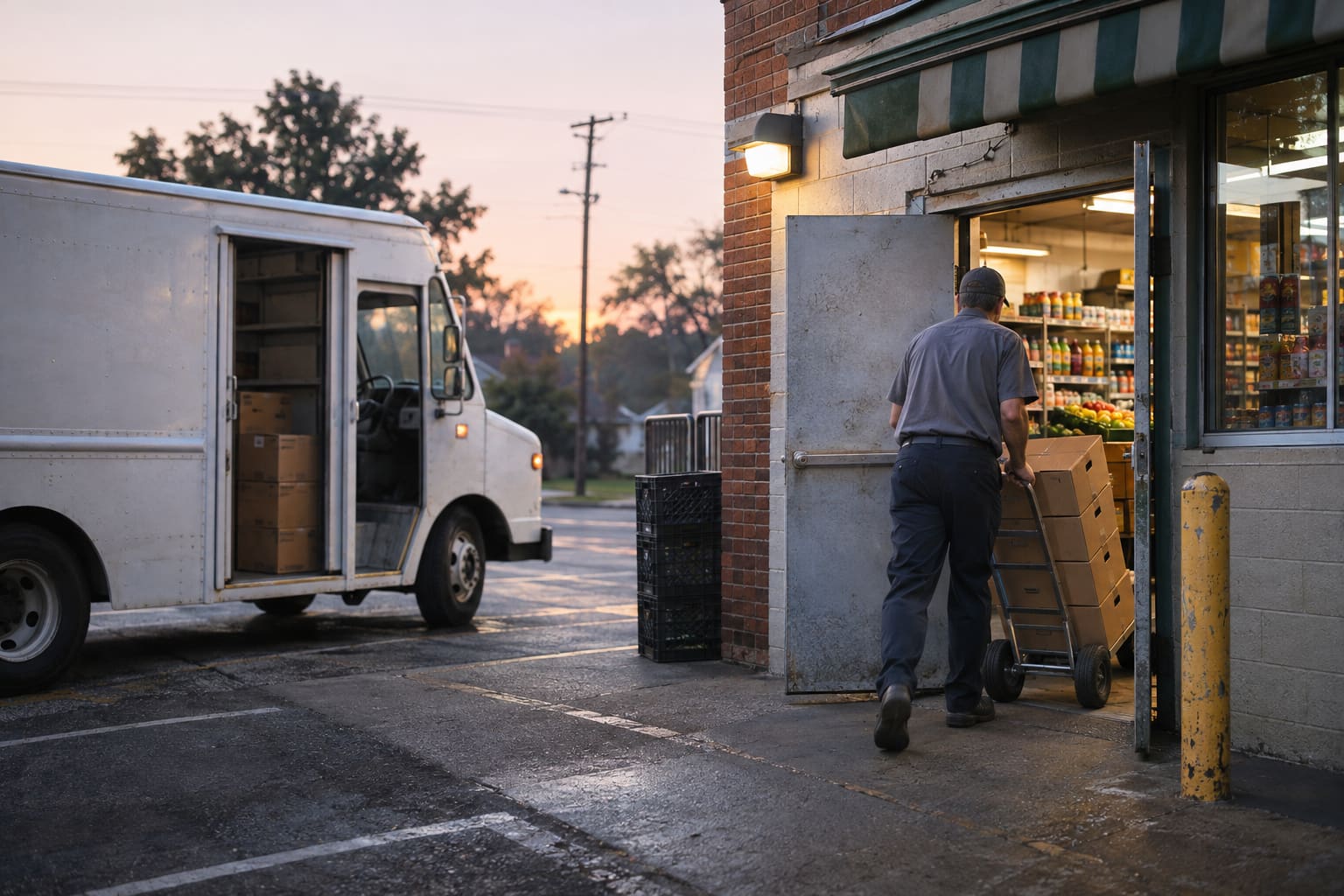
Direct store delivery, or DSD, is a distribution model in which a manufacturer or distributor delivers product straight to the store, skipping the retailer's central warehouse. Shipsy describes it as delivery "directly from its plant or depot to the retailer's store." Route sales is the selling side of it: a rep or driver who calls on the same stores on a set schedule, checks the shelf, takes the order and, on many routes, delivers it.
That is the DSD meaning in one paragraph. The rest of this article is about how a route actually runs for a beverage, snack, bakery, dairy or specialty food distributor: the three selling models, the route rep's day, how to design routes that repeat, what a good store visit includes, and which numbers to watch. It also covers when DSD pays and when a warehouse delivery is the better answer.
What DSD distribution includes
DSD is more than freight. Infios says it "often includes services beyond standard freight delivery," and lists stocking shelves, rotating inventory, and placing and merchandising products. Delivery, replenishment and merchandising happen in one store visit, by one person.
Shipsy lists the categories where the model is common: beverages, bread and bakery, dairy and chilled, snacks and confectionery, and tobacco. The reasons differ by category. Beverages are heavy and come with returns and empties. Bread has to be fresh every day. Dairy needs the cold chain. Snacks sell by shelf space and impulse placement. A specialty food distributor with short-life products sits in the same group.
The cost is real. The same Shipsy page says DSD has a higher cost to serve than warehouse-routed delivery and is uneconomical for slow-selling products. Because each stop is expensive, everything below is about getting more from each stop and fewer wasted miles between them.
Pre-sell, truck-sell and advance-sell routes
A DSD route sells in one of three ways. The names vary by company, so here is how this article uses them.
| Model | How the order is taken | When product reaches the store | Best for |
|---|---|---|---|
| Pre-sell | A sales rep visits, checks the shelf and takes the order. A separate truck delivers it. | The next day or two. Shipsy says pre-sell orders are taken 1 to 2 days ahead. | Stores that need more selling than a driver has time for: new items, displays, promotions. |
| Truck-sell (van sell) | The driver carries stock, builds the order on the spot and settles it at the door. | At the visit. | Short-life products and stores that reorder the same items every time. |
| Advance-sell | The store orders by phone, portal or a standing order before the visit. No sales call is needed to get the order. | At the next scheduled delivery. | Steady reorder accounts where the visit is for delivery and shelf work. |
Shipsy notes that most modern DSD networks combine pre-sell and van sell. A common pattern is a truck loaded with the pre-sold orders plus extra stock for stores that need a top-up. The truck-sell part makes the driver a seller, and the pre-sell part frees the driver to do shelf work.
Pre-sell versus route sales
People search for "pre-sell vs route sales" because the two words are used loosely. Route sales is the broad term: any rep or driver working a fixed set of stops. Pre-sell is one way to run it, where selling and delivering are split into two visits. If your reps both sell and deliver, you run truck-sell. If one person sells and another delivers, you run pre-sell. Most distributors need a rule for which stores get which model, and the rule should follow how much selling the store needs.
A route rep's day
A DSD route rep's day has a fixed shape, and the shape is why repeat schedules work. This is a hypothetical truck-sell day for a beverage route with 26 stops, with times to show the order of work rather than a standard.
- 4:30 am, depot. Load the truck to the day's plan: pre-sold orders first, then extra stock for top-ups, in the order the stops will be served so the first stop is at the back door of the truck.
- 5:15 am, first stop. Walk the shelf and the back room, count what is there, pull anything past its date, build the order, deliver it, and rotate older stock to the front.
- Every stop after that. Check the shelf against the plan, fix any gaps, write what the store said, take any returns or empties, and leave with a signature or a confirmation.
- Midday. Reload if the truck is empty. Rework the afternoon order if a stop took longer than planned.
- 2:30 pm, back at the depot. Hand in cash, returns and the day's orders, and note which stops were missed or short.
The depot and the settlement are back-office work. The part a sales manager can improve is the middle: how long each stop takes, whether the stops are in a sensible driving order, and what the rep does at each one.
Route design and repeat schedules
A DSD route works because the store knows the delivery day. Build routes so that each store is visited on the same weekday at about the same time, and set how often each store needs a visit. A big store that sells out of bread every day may need three visits a week. A small store that sells a case of snacks a week may need one. This is the same method as a call cycle, with delivery frequency in place of sales visits.
Then order each day's stops by driving distance, because every wasted mile at 26 stops a day adds up. Windshield time covers how to measure it and cut it. Cluster stops so the truck is not crossing the same road twice, and keep delivery windows in mind: a store that only accepts product before 7 am goes first, whatever the map says.
Store visit standards
Two reps on the same route can get different results from the same stores because they do different things at the shelf. Write down what every visit includes. Pepperi's DSD best practices say field staff should have product catalogs, customer history and account promotions on the device, and that managers need real-time information on staff locations and completed tasks. The visit standard below turns that into the steps a rep follows.
Store: ______  Route: ______  Day: ______  Rep: ______
1. Arrive in the delivery window. Check in.
2. Walk the shelf and the back room. Note out-of-stocks: ____ items.
3. Pull product past its date or damaged. Count it: ____ units (returns or stales).
4. Rotate older stock to the front. Fill every gap the delivery can fill.
5. Check the shelf set, price tags and displays against the plan. Fix or photograph the gap.
6. Build the order with the store. Mention one new or promoted item.
7. Deliver, collect the signature or confirmation, take away returns and empties.
8. Note what the store said: complaints, competitor activity, anything that changes the next order.
9. Check out. Time at the store: ____ minutes.
Step 8 is the one that usually gets skipped, and it is the one a manager can use. A store that complains about late deliveries twice in a month is a store that is about to cut its order. Notes in the visit record are how the next rep, or the manager, finds out.
What to measure on a DSD route
Five numbers tell you most of what you need to know about a route. Track each one by route and by rep, and read it weekly. Two reps on similar routes with very different numbers point to the habit worth copying.
| Measure | How to calculate it | Example | What it tells you |
|---|---|---|---|
| Stops per day | Visits completed divided by working days | 26 stops in a day | Whether the route is the right size, and where time is lost |
| Sales per stop | Route sales divided by stops | $18,200 a week over 130 stops is $140 per stop | Whether the stops are worth driving to |
| Out-of-stock rate | Items found empty divided by items checked | 9 empty of 120 checked is 7.5 percent | Whether delivery frequency and order quantity match demand |
| Returns and stales | Units returned or pulled divided by units delivered | 180 of 6,000 is 3 percent | Whether you deliver too much or rotate stock too slowly |
| Visits made against plan | Visits made divided by visits planned | 61 of 66 is 92 percent | Whether the schedule is deliverable, and where visits are being skipped |
The out-of-stock rate and the returns rate pull in opposite directions. Deliver more and the shelf is full, but returns go up. Deliver less and returns fall, but the shelf has gaps. The right order quantity sits where the two together cost you the least. More on choosing the measures to report is in field sales KPIs.
When DSD makes sense and when warehouse delivery does
Infios says DSD adds the most value for fast-moving or perishable products, for competitive shelf environments where the maker wants control over placement and promotions, and where stores need tracking at the store level. Shipsy says it is uneconomical for slow-selling products. A simple test follows from that.
| Question | DSD fits when | Warehouse delivery fits when |
|---|---|---|
| How fast does it sell? | The shelf empties in days | Weeks of stock sit on the shelf |
| How long does it last? | Days or weeks | Months |
| Does shelf work change sales? | Yes: placement, rotation and displays move the numbers | No: stores restock without help |
| How dense are the stores? | Many stores close together on one route | Few stores, far apart |
| What does a stop earn? | More than a stop costs | Less than a stop costs |
For stores too far from the route, or too small for a stop, many suppliers send the order through a wholesaler or from the warehouse and keep DSD for the stores where the shelf work pays. Penske Logistics notes that DSD relies on just-in-time deliveries and suits operations with daily fresh deliveries.
What to do this week
- Pull one route's last four weeks and calculate the five measures in the table above.
- Mark each store pre-sell, truck-sell or advance-sell, and move any store that is not working.
- Write the store visit standard on one page and ride along on one route to see what is really done.
- Compute cost per stop for your least dense route and check it against the margin a stop earns.
- Put each route on a repeating schedule so the delivery day does not move.