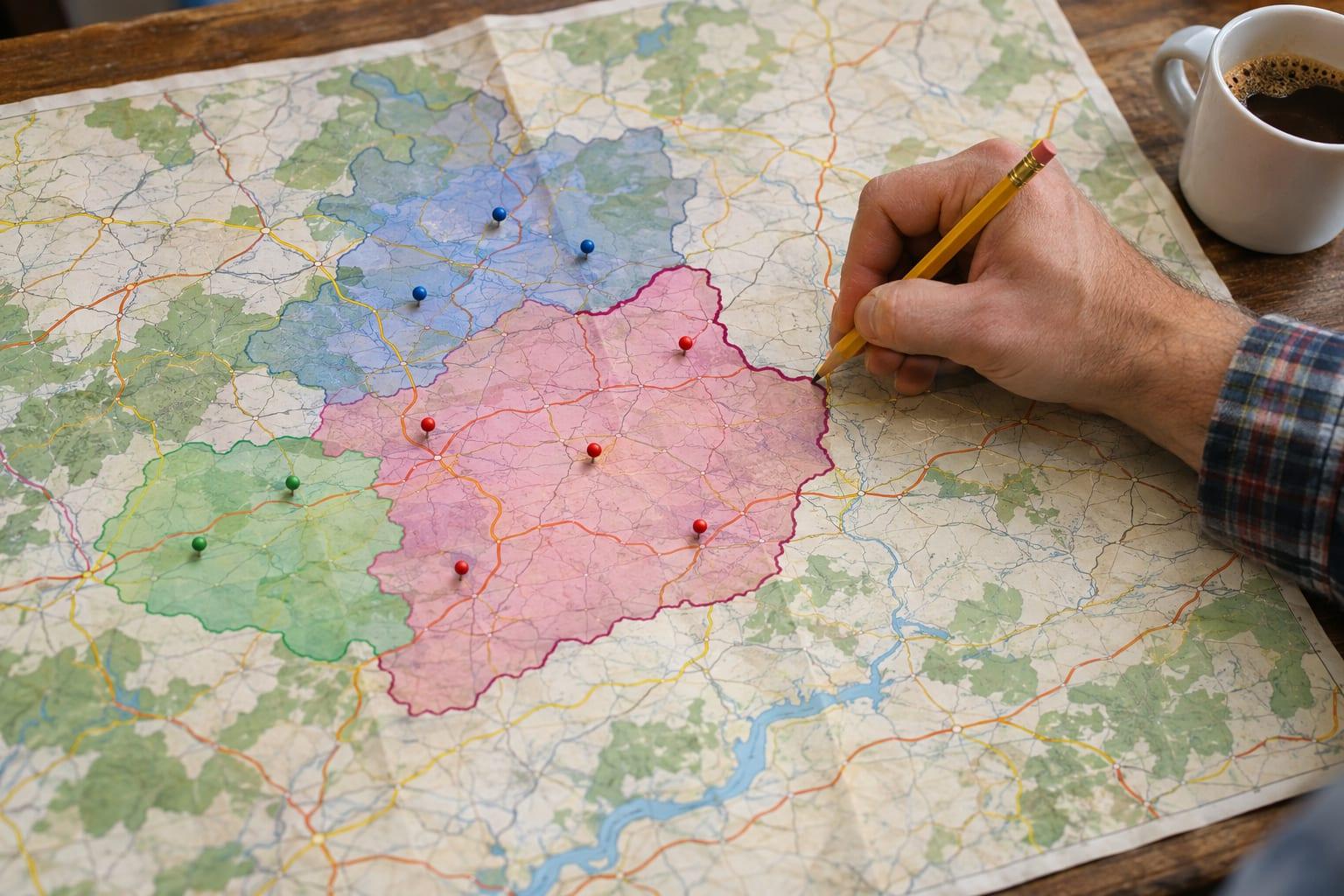
A sales territory is the group of customers and prospects that one salesperson or team is responsible for selling to. It can be defined by place, such as a county or a state, or by something else, such as an industry, a product line or a list of named accounts. The owner gets the work, and the credit, inside it.
That is the whole idea, and it is a simple one. A territory answers the question "whose account is this?" before two reps ask it at the same customer's front desk. The rest of this article covers the types of territory, examples with numbers, who owns one, and how to tell a good one from a bad one. If you are ready to build them, go straight to how to create a sales territory plan.
What a sales territory is for
A company with one rep does not need territories. The rep sells to everyone. The trouble starts with the second rep, because now two people can call the same buyer, or nobody calls a buyer because each rep assumed the other had it. A territory fixes three things at once.
- Ownership. Every account has one name next to it. When a customer complains, the manager knows who to ask.
- Coverage. The territory is the list of accounts that must be visited. If the list is long, the manager can see that before the rep falls behind.
- Fairness. Pay and quotas make sense only if reps start with a comparable amount of work and opportunity.
The word "territory" is used loosely. Some companies say territory, some say region, patch, book or route. In this article, a territory is one rep's slice. A region is usually a bigger unit made of several territories, with a manager over it. Sales regions are covered near the end.
Types of sales territories
There are six common ways to divide accounts. Most small teams start with geography, because it is easy to explain and easy to see on a map. Larger teams usually combine two or more.
| Type | How accounts are divided | When it fits |
|---|---|---|
| Geographic | By area: zip codes, counties, states, or a drawn outline | Reps visit in person, and driving time is the main cost |
| Named account | By a list of specific customers, wherever they are | A few large customers each need a dedicated owner |
| Industry or vertical | By the type of customer: clinics, schools, restaurants, contractors | Buyers in one industry share needs and vocabulary that a specialist learns |
| Product | By what is sold: one rep per product line | Products are technical enough that one person cannot know them all |
| Channel | By how the sale happens: direct, distributor, dealer, online | Different routes to market need different skills and different pay |
| Hybrid | Two or more of the above, such as area first and then named accounts | The team has grown, and a single rule creates too many exceptions |
Geographic territories
This is the type most people picture. A rep owns an area and everything in it. Geography suits field teams best, because the biggest cost of a visit is the drive. A compact area means more visits a day. The risk is that area alone ignores how much each account is worth, so one rep gets a rich area and another gets a poor one.
Named-account territories
Here the territory is a list, not a place. A national chain with forty sites might be one named account, owned by one person, even though the sites span six states. Companies use this when the buyer decides centrally. Splitting that chain by geography would give it six reps and no single voice. The key account management guide goes deeper on running these.
Industry and product territories
A rep who sells only to dental offices learns how dental offices buy. A rep who sells only the safety line learns the safety line. The price is travel. Specialists often overlap geographically, so two reps may drive to the same town in the same week. Teams accept that when the knowledge gain outweighs the driving.
Channel and hybrid territories
A channel territory separates how you sell, for instance one rep for direct customers and one for dealers who resell. A hybrid combines rules, and most mature teams end up here: geography decides the default, and a short list of named accounts is carved out for senior reps. Keep the carve-outs short. Every exception is a rule someone has to remember.
Sales territory examples
These examples are hypothetical. The numbers are made up to show how the types work, and yours will differ.
Example 1: a distributor with three geographic territories
A regional building-supplies distributor has three field reps and 240 customer accounts. It divides the market by area.
| Territory | Area | Accounts | Last 12 months revenue | Typical drive between stops |
|---|---|---|---|---|
| North | Three counties around the metro area, dense | 95 | $2.1 million | 10 to 15 minutes |
| East | Two counties with mid-size towns | 80 | $1.9 million | 20 to 30 minutes |
| West | Four rural counties | 65 | $1.8 million | 35 to 50 minutes |
The territories are very different in size on the map. North is small and has the most accounts, because stops are close. West is large and has the fewest, because every stop costs a long drive. The revenue is close to even, so each rep has a fair chance at the same earnings. The area is not equal, and it should not be.
Example 2: a software team with named accounts and verticals
A company selling scheduling software to service businesses has four reps. Two take named accounts: the 12 largest customers, split six each. The other two split everything else by vertical, one covering healthcare practices and one covering home services. Geography does not matter here, because the reps sell mostly by video. The named-account reps handle fewer accounts with higher contract values.
Example 3: a food supplier with a hybrid
A food supplier gives each of five reps a geographic territory of about 70 restaurants and shops. Then it carves out the three regional grocery chains as named accounts under a sixth person. Everything else follows the map. A new restaurant that opens in someone's area is theirs on the day it opens. A new store of one of the chains goes to the chain's owner. Two rules, short enough to fit on a card.
Who owns a sales territory
Two jobs share the word. Companies use different titles for them, but the split is common. The territory sales rep works the territory. The territory sales manager is responsible for how a group of territories performs.
| Territory sales rep | Territory sales manager | |
|---|---|---|
| Owns | The accounts inside one territory | A group of territories and the reps in them |
| Day to day | Visits customers, answers questions, quotes, follows up, finds new prospects | Reviews coverage, coaches reps, moves accounts between territories, hands out new leads |
| Measured on | Sales in the territory, visits made, new accounts won | Sales across the group, how evenly work is shared, how long reps stay |
| Typical week | Several days on the road, a day for notes and planning | Time with reps in the field, a weekly review, planning with the sales leader |
In many small companies the same person does both. The owner or sales manager has a territory and also decides where the lines go. That works until the manager's own territory suffers, which it usually does, because the manager is pulled away to fix everyone else's. The weekly routine for the manager's side is in sales territory management.
Territory titles vary by industry. In equipment, food, medical supply and building products, "territory sales manager" often means a senior field rep who owns one area and has no direct reports. That is a different job from a manager of managers. Read the job description for who the person manages, not the title alone.
What makes a territory good or bad
A good territory is one a capable rep can cover fully and earn a fair living from. Four things decide that.
- Workload. The visits the accounts need in a year, compared to what one rep can do. If the visits needed exceed what fits in the calendar, accounts go unseen. If they fall far short, the rep has idle days.
- Potential. The revenue in the territory now, and what is still unsold. Two territories with equal workload can hold very different money.
- Compactness. A tight shape means short drives. A long strip, a ring around another rep's area, or a territory split by a river with no bridge adds hours of driving.
- Overlap. If two reps can both claim an account, neither owns it. A good territory has a clear edge, and a rule for the accounts that sit on it.
A bad territory fails one of the four, and the rep usually notices before the manager does. For the method to measure workload and potential with real numbers, see the territory plan guide. The drive-time part is explained in windshield time.
How to assign territories and keep them balanced
Assigning a territory is two decisions: where the lines go, and which rep gets which area. Balance means each rep has a similar amount of work and a similar chance to earn. Workload and opportunity move separately, so measure both before you hand anything out.
- Count the work for every account. Visits needed in a year, from the call cycle, multiplied by the visit length plus the drive. Add them up per area.
- Count the opportunity. Sales in the last 12 months, plus the accounts that could buy more. Reps know which is which.
- Draw the areas to be compact first. Short drives matter more than a perfect split of revenue.
- Compare the areas on both numbers. If one area has 30 percent more work and 10 percent less revenue, move accounts across the line.
- Match rep to area. A rep who knows a trade, speaks the customer's language or already has the relationships may fit one area better. Fit can outweigh a perfect balance, but write down the reason.
- Keep the best accounts where the relationship is. Moving a long-held account to even out numbers risks the customer. Move new accounts and prospects first.
| Territory | Visits needed a year | Sales last 12 months | Verdict |
|---|---|---|---|
| North | 1,350 | $1.9M | Right size for one rep |
| East | 1,700 | $1.4M | Too much work for the money. Hand some accounts to West |
| West | 1,000 | $2.1M | Room for East's accounts, and the most revenue per visit |
A rep covering 1,350 visits a year at about 6 visits a day needs about 225 field days, which leaves room in a normal year. At 1,700, the same rep needs 283 days, more than there are. The visit counts here are made up, so use your own. The method is in how to create a sales territory plan, and sales territory alignment covers redrawing lines without losing relationships.
Signs a territory is the wrong size
Territories rarely stay right. Customers open and close, and one large account can change a rep's year. These are the signs, with the cause behind each.
| What you see | Likely cause | What to try |
|---|---|---|
| Overdue accounts climb for weeks, and the rep is out every day | Too big: more visits needed than days available | Move a cluster of nearby accounts to a neighbor |
| Empty days on the calendar, and every account is seen on time | Too small: not enough accounts to fill the week | Add accounts or give the rep prospects to work |
| The rep spends half the day driving | Too spread out, or the shape is stretched | Reshape it to be more compact, or swap accounts with a neighbor |
| One rep's sales are double another's with the same effort | Potential is uneven | Rebalance revenue at the next yearly review |
| Two reps call the same customer | Overlap and no rule for edge cases | Write the tie-break rule, and give each account one owner |
| Reps ask for the best accounts of the others | The split feels unfair | Compare workload and potential openly, with numbers |
Tools for planning territories: CRM, map and spreadsheet
Three kinds of tool help, and each answers a different question. Most small teams start with a spreadsheet and add the others when it stops being enough.
| Tool | Good at | Weak at |
|---|---|---|
| Spreadsheet | Counting accounts, visits and sales per area, and trying a split in minutes | Showing where customers are, and staying current once reps are visiting |
| Mapping tool | Seeing clusters, gaps and overlap, and drawing a border around a set of customers | Holding the customer's history and sales, unless it is linked to a CRM |
| CRM | Showing who owns each account, the visit history, and what each territory sold | Drawing the map, unless it has a map built in |
The usual order is the spreadsheet for the numbers, the map for the shape, and the CRM to hold the owner on each account afterward. A territory that exists only on a map goes stale because nobody updates the owner on the customer record. A territory that exists only in a CRM field can hide a bad shape that costs hours of driving.
Sales Perch puts the map and the customer record together. A manager draws a territory on the map, and each territory shows how many customers and prospects fall inside it and how many prospects nobody owns yet. See sales territory mapping and the field sales CRM.
Sales regions: territories one level up
A sales region is a group of territories under one manager. A company with 18 reps might have three regions of six territories each. Regions are for management: forecasting, hiring and coaching. Territories are for selling. The two follow the same rules, so everything above about workload, potential and compactness applies at both levels.
When regions and territories are drawn on different logic, such as regions by state and territories by customer cluster, you get territories that straddle a state line and have two managers. Draw the territories first, then group them into regions that follow the same borders.
Where to go next
What you do next depends on where your team is today.
- You have no territories yet. Read how to create a sales territory plan for the account table, the sizing math and a one-page template.
- You have territories and they are running. Read sales territory management for the weekly review, hand-overs when a rep leaves, and how to give every prospect an owner.
- Your territories no longer fit. Read sales territory alignment for when and how to redraw them without losing the relationships reps have built.