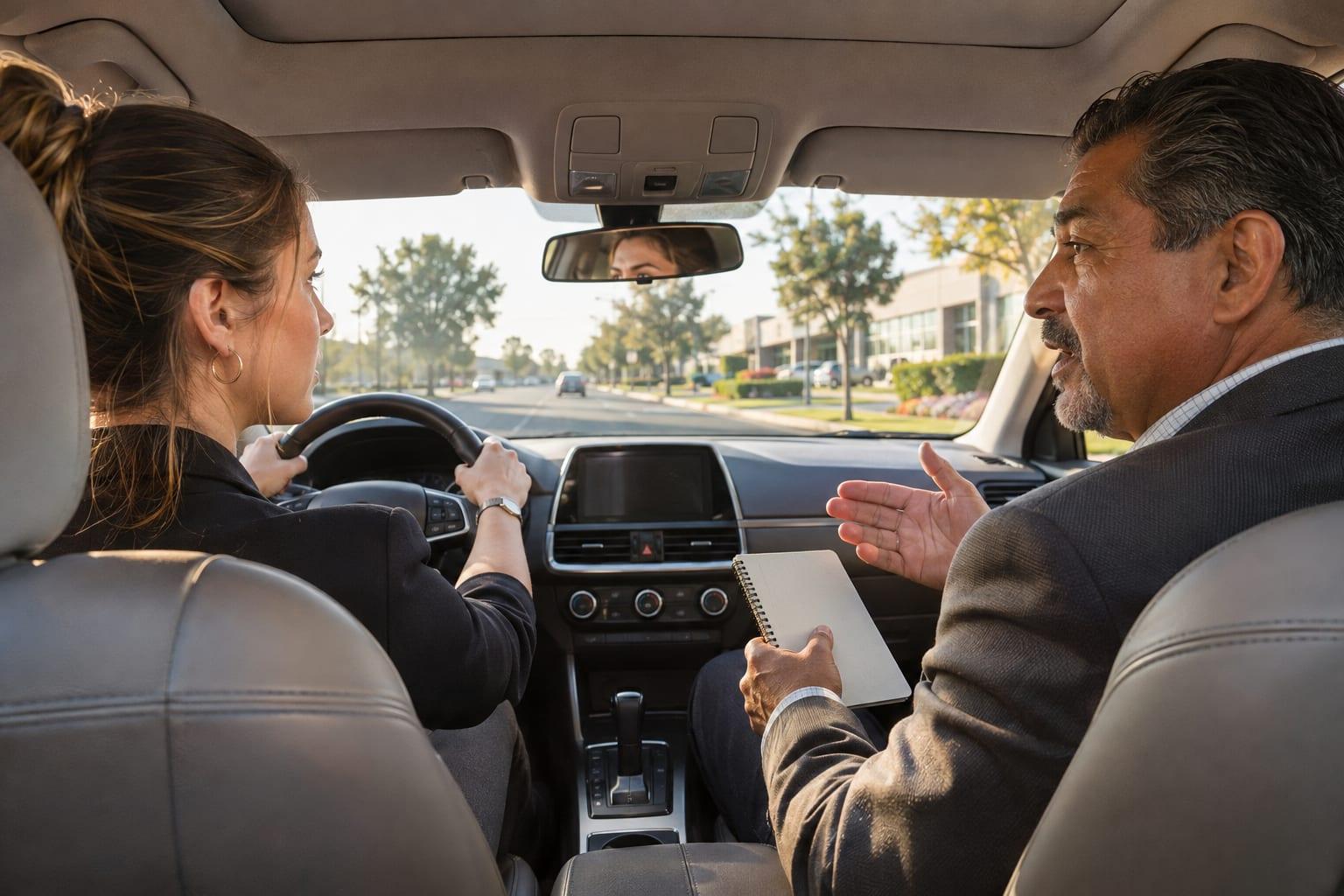
Sales coaching for field reps means watching real customer visits, giving feedback on one behavior at a time, and checking that behavior again within two weeks. Ride along about once a month, review visit notes and data between rides, and hold a short weekly one-to-one. Coaching is repeated practice on one skill, not a performance review.
Field reps are hard to coach because you rarely see the work. A desk rep's call can be recorded or overheard. An outside rep's best and worst moments happen in a customer's back office, alone. So field sales coaching depends on two sources: the ride-along, where you see the work, and the visit record, where you see the pattern. You need both.
What a sales coach is responsible for
Coaching is one of three jobs a sales manager does, and it is easy to confuse with the other two.
| Job | Who it is for | What it looks at | Typical question |
|---|---|---|---|
| Managing | The whole team | Results against targets | "Why are we under plan this month?" |
| Training | A group, at one time | Knowledge and a method | "Here is how we quote a standing order." |
| Coaching | One rep, over weeks | One behavior in real visits | "What did you ask when he said fine?" |
A coach has three responsibilities, and each depends on the one before it.
- Build trust. A rep will not try a new way of opening a visit in front of a manager who uses what they see against them. Say at the start that the ride is for practice, not for review. Keep what you see in the car between the two of you. Ride with your strongest reps too, so a ride is not a warning.
- Give feedback the rep can use. Feedback is specific, about one behavior and given soon after the visit. The four steps in the next section are the format.
- Hold the rep to what was agreed. Each coaching session ends with one thing to try and a date to look again. Looking again is the manager's half of the deal. A manager who does not check teaches the rep that it did not matter.
The skills behind those three are small and learnable. Ask a question and wait for the answer. Stay quiet at the customer. Describe what you saw in words you could quote. Say what you do not know. Admit your own misses, because a rep who hears a manager say "I lost that account the same way" is more willing to say what went wrong. For a rep in their first three months, coach against a 30 60 90 day sales plan; for everyone else, review a sales scorecard monthly.
A five-minute debrief after a ride-along stop
- Minute one: ask. "How did that go? What would you change?"
- Minute two: say what worked. One specific thing, in the rep's own words where you can.
- Minutes three and four: one change. Describe the behavior, the effect and one thing to try at the next stop.
- Minute five: agree and write it down. The rep says the plan back to you, and you put the check date in your calendar.
Decide what you're coaching before you ride
Pick one skill per ride. A manager who tries to fix opening, questions, pricing talk and notes on a single day fixes none of them, and the rep stops listening by lunch.
Choose the skill from evidence. Look at the rep's last month of visits, notes and account results, and ask which single change would move the numbers most. The common candidates for reps who visit the same business customers repeatedly:
- Opening a visit with a reason, not "just checking in"
- Asking what changed at the customer since the last visit
- Spotting a reorder gap, a competitor's product or a new decision-maker
- Asking for the next order or the next step before leaving
- Writing a note that the next rep could use
- Handling a price objection without discounting first
Tell the rep the focus a day ahead. "On Thursday I want to watch how you open the visit and what you ask in the first two minutes" is a fair brief. It turns the ride into practice and not an inspection.
How to run a ride-along
Before the first stop
- Agree the focus and the rules in the car. You're there to watch. The customer relationship belongs to the rep.
- Agree how you will be introduced. A short line works: "This is my manager, here to see how we can support you better."
- Choose the stops together. Include one strong account, one slipping account and one routine stop. You see the rep at their best and at their hardest.
- Agree a signal for when you may step in, and expect not to use it.
At the customer
Stay quiet, take short notes, and keep your phone away. Don't finish the rep's sentences. If the rep is about to make a mistake that doesn't cost the account, let it happen. You can only coach what you have seen.
| Point in the visit | What to watch | Question for the debrief |
|---|---|---|
| Arrival | Do they know the customer's last order, last note and any open issue before walking in? | "What did you want from this visit before we went in?" |
| The opening | Is there a stated reason for the visit, or small talk until something comes up? | "What did you want them to take away in the first minute?" |
| Questions | Open questions about the customer's business, or only about the order? | "What did you learn that is new?" |
| Objections | Does the rep listen to the whole objection, or reach for a discount? | "What was behind the price comment?" |
| The ask | A request for a specific order, trial or date, or a vague "let me know"? | "What did you ask them to do, and by when?" |
| Check-out and notes | Is the note written at the door, with the next step and the name of anyone new? | "What will the next person need to know?" |
In the car afterward
Debrief within 15 minutes, in the car and not in the customer's lot, while the visit is fresh. Give the feedback after each visit, not after the last stop, because by evening the details blur. Keep the debrief to five minutes per stop. The next section gives the structure.
Give feedback in four steps
Good feedback is specific, about a behavior the rep can change, and agreed by the rep. This four-step structure keeps the manager from lecturing and the rep from defending.
- Ask first. "How did that go? What would you do differently?" Reps often name the problem you were about to raise, and they act on what they said.
- Name one behavior you saw. Say what happened, not what it means about the person: "You asked how the order looked and moved to the next topic when he said fine." Don't say "You were too passive."
- Say the effect. "He said fine, and we learned nothing about the new warehouse he mentioned on his way out."
- Agree one thing to try, and when you will look again. "At the next two stops, ask what has changed since last time. I will check your notes on Friday."
Rep: ____________  Customer: ____________  Date: ____________
Focus for today: ____________

What I saw (the behavior, in words I could quote):
____________

What the effect was:
____________

One thing that worked:
____________

What the rep said they would change:
____________

Try this at the next ____ visits. I will check on: ____________ (date)
Three coaching examples from ride-alongs
The three examples below are hypothetical. The reps, the customers and the numbers are made up to show the shape of a good coaching exchange: what the manager saw, what the manager said and what changed.
Hypothetical example 1: the opening
What the manager saw. At all three stops, the rep opened with "just checking in" and waited for the buyer to bring up a problem.
What the manager said. After asking how the visits went, the manager said, "At the second stop you said you were checking in, and Maria said everything was fine. We left without learning why her order was smaller last month. At the next two stops, start with a reason: 'Your order was down last month, and I want to hear what changed.' I will read your notes on Friday."
What changed. In the next eight visits, the rep opened with a reason at six. In the notes, "what changed at the customer" appeared in six of eight reports, up from two of eight the month before.
Hypothetical example 2: the price objection
What the manager saw. A buyer said, "Your price is high." The rep offered 5 percent off before the buyer had finished the sentence.
What the manager said. "You gave up 5 percent in about four seconds. I do not know what the price was being compared with. Next time, ask 'High compared with what?' and wait. Tell me what you hear."
What changed. At the next stop, the buyer's answer was a competitor's faster delivery, not a lower price. The rep offered a standing delivery day and kept the price. Over four price comments in the following two weeks, the rep gave a discount once.
Hypothetical example 3: an account, not a skill
What the manager saw. In the visit record, a customer that had ordered about $14,000 a month was down to $9,500 for two months, and the notes said "visited, fine" both times.
What the manager said. The manager and the rep spent 20 minutes planning the next visit to that one account. They agreed to ask who decides, what the customer buys from others and what the late deliveries had cost. The manager did not join the visit.
What changed. The rep learned that the customer had moved part of the volume to another supplier after two late deliveries. The rep brought a delivery fix, and the account came back to $12,000 over the next two months.
Account coaching and skill coaching
The first two examples are skill coaching and the third is account coaching. Both belong in a field team, and they answer different questions.
| Account or deal coaching | Skill coaching | |
|---|---|---|
| Focus | One customer or one open quote | One behavior that shows at many customers |
| Question | "What do we do at this account?" | "How do you open or ask or handle an objection?" |
| Time frame | The next visit or the next two weeks | A few weeks of practice |
| You measure it by | The account's orders and the next step | How often the behavior shows up in visits and notes |
| The risk | The manager takes over the account | The talk stays abstract and nothing changes at the next stop |
Use account coaching when a decision is due soon, such as a large account slipping or a quote about to expire. Use skill coaching when the same gap shows at several accounts. Often one ride does both. The skill is the focus, and the stops you choose are the accounts that matter.
Coach from visit data and notes between rides
You can't ride with every rep every week. A manager with eight reps who rides a half day with each one monthly spends four days of a roughly 21-day working month on rides. That's fair, but it leaves most days unseen. The visit record covers those days.
Look at five things before each weekly one-to-one, and bring one question to the call.
| What you read | What it can show | Question for the rep |
|---|---|---|
| Accounts past their visit interval | Avoidance of a hard customer, or a route that is too long | "Which of these is hardest to get to, and why?" |
| Customers buying less than usual | An account drifting before anyone has noticed | "What did the last visit tell you about this account?" |
| Visits that ran under a minute | A drop-off, a closed door or a visit that didn't happen | "What happened at this stop?" |
| Notes: length, specifics, next steps | Whether the rep is learning anything at the customer | "What would you want to know before the next visit here?" |
| Time at the customer, by account tier | A rep who rushes the big accounts and lingers at the friendly ones | "Where do you spend the time you have?" |
Read the notes first, and set a standard for them with a call report template. A note that says "Visited. Fine." ten times in a row tells you more about the coaching need than any number. A note that says "Buyer is leaving in March. New buyer is Dana, wants samples" shows what good looks like, so read it aloud in the next team meeting with the rep's permission.
Use the data to open a conversation, not to ambush anyone. A short visit may have a good reason. Ask before you conclude. For the numbers to check, see field sales KPIs, and for how to handle flagged visits fairly, see GPS tracking for sales reps.
Coaching technology: what each tool shows and misses
Tools help a manager find where to look. They do not coach. For a field team, a few of them matter more than the rest.
| Tool | What it shows | What it misses |
|---|---|---|
| CRM visit history and notes | How often each account is seen, what the rep wrote, which accounts are overdue | What was said in the room |
| Order and invoice data | Which accounts are buying less than they did | Why they are buying less |
| Call recordings | The words of a phone call, for review and practice | In-person visits, which are the bulk of field work, and they need the other person's consent |
| A shared scorecard | The same short checklist applied to every ride, so ratings can be compared | Anything not on the checklist |
| A shared spreadsheet | Coaching notes and check dates for each rep | Nothing about the visits themselves |
A scorecard can be simple. Rate each behavior on a ride from 1 to 3, with one sentence of evidence, and put it in a sheet next to the date. The same four or five behaviors on every ride give you a before and an after. If you record calls, check the consent rules where you and your customers are, because they differ by place.
The limit of every tool is the same. A record shows what happened and a recording shows what was said. Only a conversation with the rep tells you why. Use the tools to choose the question, and ask it.
Set a coaching cadence you can keep
A cadence you keep beats a better one you drop in March. Fit it to the hours you have.
| What | How often | Time | Purpose |
|---|---|---|---|
| One-to-one with each rep | Weekly | 20 minutes | One behavior, one account, one action |
| Ride-along with each rep | Monthly, half a day | 4 hours | See the work and practice one skill |
| Ride-along with a new rep | Weekly for the first month | Half day | Set habits early |
| Review of notes and data | Before each one-to-one | 10 minutes per rep | Choose the one question |
| Skill review across the team | Quarterly | 1 hour | Find the skill most reps share a gap in |
For eight reps, the weekly one-to-ones take about 2 hours 40 minutes, plus another 80 minutes of preparation. Add the monthly rides, which come to four working days. That's about 4 hours a week, plus the rides. If that is more time than you have, ride less often and keep the weekly one-to-one. The weekly conversation does the most between rides.
Coach the middle of the team as often as the bottom. The weakest rep needs the most attention, but a strong rep with one fixable gap returns the most for an hour of your time.
Measure whether coaching works
Measure two kinds of thing for each rep. Leading measures are the behaviors you coached, which move in days. Lagging measures are the results those behaviors should produce, which move in weeks or months. Track both, and compare each to the rep's own starting point.
| Leading: the behavior | Where you read it | Lagging: the result | Where you read it |
|---|---|---|---|
| Visits that open with a reason | Ride-along notes | Orders from accounts that were slipping | Invoice export |
| Notes with a next step and a date | Visit notes | Quotes won against quotes sent | Quote list |
| Accounts seen within their call cycle | Visit record | Sales per account against last year | Invoice export |
| Asks for a specific order or date | Ride-along notes | New products or customers placed | Invoice export |
Take a baseline before you start. Read four weeks of the leading measure, coach one behavior for two to four weeks, then read the same measure again.
| Measure | Four weeks before | Four weeks after |
|---|---|---|
| Visits that open with a reason (from ride-alongs and notes) | 2 of 8 sampled | 6 of 8 sampled |
| Notes with a next step and a date | 40% | 85% |
| Accounts seen within their cycle | 70% | 88% |
| Orders from the five slipping accounts | $31,000 | $34,500 |
Three cautions apply. The behaviors move first and the money moves later, so do not judge coaching on two weeks of sales. One rep's numbers are small, and a single large order can swing them. Season also changes orders, so compare with reps you did not coach on that behavior over the same weeks. For the numbers behind these measures, see field sales KPIs.
Mistakes that make coaching fail
- Taking over the visit. The customer sees a rep who needs a manager to close, and the rep sees you didn't trust them.
- Coaching five things at once. One behavior, two weeks. Then the next.
- Coaching only after a bad number. Reps learn that your arrival means trouble. Ride with the top reps too.
- Feedback with no follow-up. If you don't check the agreed behavior, the rep concludes it didn't matter.
- Using data as a verdict. A flagged visit or a quiet account starts a question. It doesn't end one.
- Debriefing in front of the customer or in the lot. Wait until you're alone.
Start this week
- Choose one rep and read their last month of notes and visits.
- Pick the one behavior to coach, and tell the rep the focus for a ride this week or next.
- Ride half a day. Use the stop-by-stop watch list and take notes on the coaching note template.
- Debrief in the car with the four steps, and agree one thing to try.
- Put a check on your calendar for the following Friday. Open the notes and see whether it happened.
If you want the visit record in front of you before the first ride, you can try Sales Perch free for 30 days with your own customers.